Yes. Massage reliably reduces stress by lowering muscle tension and calming the nervous system, according to research summarised by the Mayo Clinic and a 2026 review of massage studies. Expect calmer breathing and looser shoulders within one session, with mood and sleep improving over repeated visits. It works best paired with other stress habits, not as a standalone fix.
TL;DR:
- Swedish massage is suitable for beginners, providing gentle, calming strokes that minimize soreness and promote nervous system relaxation.
- Aromatherapy enhances stress relief through scent, with lavender being the most proven option for calming and sleep improvement.
- Short-term physiological benefits include reduced heart rate and blood pressure, but cortisol levels show inconsistent responses, making massage a stress buffer rather than a cure.
- For chronic or mental stress, targeted massage focusing on neck and shoulders or a signature session combining gentle and firm strokes is most effective.
- Self-massage routines and calming oils can maintain relaxation between professional sessions, but medical issues or severe health conditions require consultation before massage.
Table of Contents
- Which type of massage for stress relief works best?
- What does the research actually show about massage and stress?
- How to match your stress pattern to the right massage
- How are essential oils used safely during massage?
- Can you do self-massage at home between sessions?
- What should you expect during a stress-relief massage session?
- When should you avoid massage or seek medical advice first?
- Sabaai Sabaai's perspective: translating evidence into practice
- Ready to book a stress-relief massage?
- Sources
- FAQ
Which type of massage for stress relief works best?
The right style depends on whether your stress sits in your head or your muscles. Swedish, or relaxation, massage uses slow, rhythmic strokes at moderate pressure, which is one of the more direct ways to nudge the nervous system out of fight-or-flight mode. It's the safest starting point if you're new to massage for stress relief or feel wired rather than physically sore.
Aromatherapy massage layers scent onto touch, usually through inhalation and a scented carrier oil applied during the massage itself. Hot stone treatments use heated stones to soften tight muscle fibres before deeper work begins, while traditional Thai massage combines stretching and compression to release tension along the body's energy lines. Deep tissue massage targets stubborn knots but can leave you sore for a day. Reflexology, focused on the feet, suits people who find full-body touch overwhelming.
- Swedish/relaxation: gentle, calming, minimal soreness afterwards
- Aromatherapy: relaxing plus a mood lift from scent
- Hot stone: deep warmth, good for chronic tension, avoid if you have circulation issues
- Thai/traditional: stretch-based, invigorating rather than sleepy
- Deep tissue: best for muscular stress, occasional next-day soreness
- Reflexology: low-intensity, foot-focused, good entry point for the touch-averse
What does the research actually show about massage and stress?
Massage produces consistent short-term drops in state anxiety and markers of autonomic arousal, such as heart rate and blood pressure, according to a research summary from Kurated. Cortisol results are less consistent. Some trials show a clear drop after treatment; others show little change, which is why researchers now describe massage as a stress buffer rather than a cure.
The mechanism behind the calming effect involves the vagus nerve. Sustained, moderate pressure appears more effective at shifting the body toward parasympathetic ("rest and digest") activity than very light touch or abrupt deep pressure, according to reporting in Massage Magazine. That's a useful detail if you've ever wondered why a firm, unhurried massage feels more settling than a rushed one.
Aromatherapy has its own evidence base, separate from touch alone. A two-week protocol of essential oil inhalation measurably changed the cortisol awakening response and lowered subjective stress in stressed adults, though the effect faded after the participants stopped using the oils. That's the pattern with most aromatherapy research: real, but time-limited and best used as a repeated ritual rather than a one-off.
What the numbers suggest: massage and aromatherapy both move the needle on subjective stress and short-term physiology, but neither produces a permanent reset. Benefits accumulate with repetition and fade without it.
- Reliable: reduced state anxiety, lower heart rate and blood pressure post-session
- Variable: cortisol change (present in some studies, absent in others)
- Time-limited: aromatherapy's hormonal effects wane once you stop using the oils
How to match your stress pattern to the right massage
Not all stress feels the same, and the massage that helps a racing mind differs from the one that helps a locked-up back.
- Mentally wired, physically fine? Book a gentle Swedish or aromatherapy massage, ideally in the evening, so the calming effect carries into sleep.
- Physically tense, mentally fine? Choose a targeted or blended session covering neck, shoulders and back. Save deep tissue work for when you're not already running on empty.
- Both at once? Ask for a Signature-style massage that opens with slower strokes before moving into firmer work on tight areas.
- For cumulative benefit, book weekly or fortnightly for four to six weeks, then taper to monthly once tension settles.
Pro Tip: Tell your therapist your stress type in one sentence before the session starts, "I'm mentally wired" or "my shoulders are locked", so they can adjust pressure and pacing from the first minute rather than guessing.
How are essential oils used safely during massage?
Lavender has the strongest track record for easing stress and improving sleep, whether inhaled or applied during massage, according to the Cleveland Clinic. Bergamot and chamomile show similar calming signals, though bergamot carries a phototoxicity risk and should be avoided before sun exposure.
Aromatherapy works best as a complement to conventional care rather than a replacement for it, and a 2024 review notes that efficacy varies enough that it should sit within a wider wellness plan, not stand alone.
- Dilute essential oils in a carrier oil before topical use, never apply neat
- Patch-test on the inner forearm 24 hours before a full treatment
- Avoid bergamot before sun exposure; check with a doctor if pregnant
- Therapists typically blend oils into massage oil or diffuse them in the room, both are effective delivery methods
Can you do self-massage at home between sessions?
Yes, a short home routine bridges the gap between professional appointments and keeps tension from building back up.
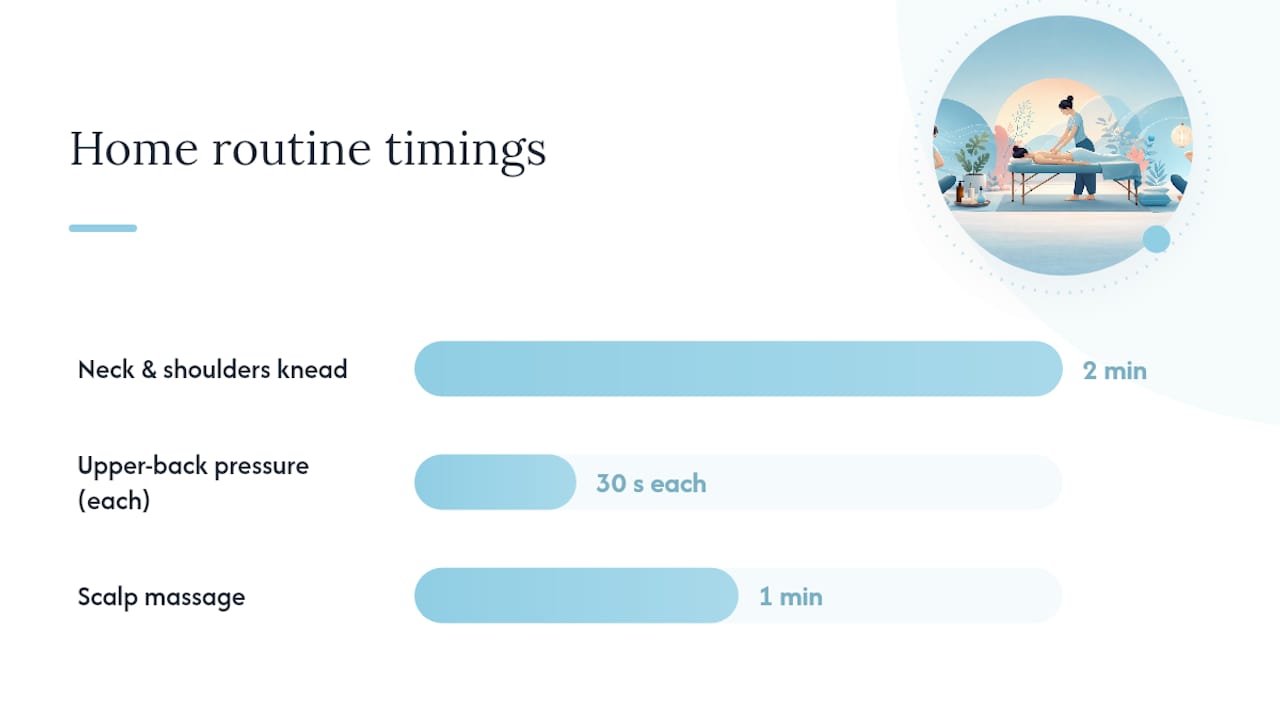
- Rub your palms together to warm them, then knead your neck and shoulders for two minutes.
- Press a rolled towel or tennis ball between your upper back and a wall, holding gentle pressure on tight spots for 30 seconds each.
- Massage your scalp in small circles with your fingertips for one minute.
- Finish with slow diaphragmatic breathing, four seconds in, six seconds out, while your hands rest on your abdomen.
Pro Tip: Do this routine right before bed rather than mid-afternoon; the parasympathetic dip it creates pairs naturally with winding down for sleep.
If pain is sharp, radiates down a limb, or doesn't ease with rest, that's a signal to see a professional rather than keep self-massaging.
What should you expect during a stress-relief massage session?
Sessions of an hour or more tend to work best for stress relief. Shorter sessions may not allow enough time for the nervous system to properly downshift.
- Tell your therapist your pressure preference and any areas to avoid before starting, not halfway through
- Book evening slots if better sleep is your goal
- Keep quiet time afterwards rather than rushing straight into screens or traffic
- Drink water and move gently (a short walk, light stretching) rather than sitting still for hours
Speak up during the session if pressure feels wrong. It's easier to adjust in the moment than to endure 60 minutes of discomfort. If you leave feeling worse, dizzy, or in sharper pain than when you arrived, that's worth mentioning to a doctor, not just your therapist.
When should you avoid massage or seek medical advice first?
Massage isn't right for everyone in every circumstance, and knowing the exceptions matters as much as knowing the benefits.
Avoid massage over areas with open wounds, active skin infections, unexplained lumps, or recent fractures. If you have a bleeding disorder, are on blood-thinning medication, or have deep vein thrombosis, speak to a doctor before booking, since pressure on affected areas can carry real risk. Pregnant clients should seek a therapist experienced in prenatal massage and avoid deep abdominal work, particularly in the first trimester.
People with severe osteoporosis, active cancer treatment, or uncontrolled cardiovascular conditions should get medical clearance first, since even moderate pressure can be inappropriate for these situations. Fever, active infection, or feeling generally unwell are also reasons to reschedule.
On the mental health side, massage is not a substitute for treating clinical anxiety or depression. Clinical resources consistently frame it as a supportive addition to a wider care plan, not a replacement for it. If stress has tipped into persistent low mood, panic, or sleep loss lasting weeks, a conversation with a GP or therapist should sit alongside, not instead of, any spa booking.
Sabaai Sabaai's perspective: translating evidence into practice
Sixteen years of hands-on practice teaches you things a study can't. Sabaai Sabaai blends traditional Thai techniques with spa rituals like Hinoki onsen bathing, pacing pressure to match each client's nervous system rather than applying one fixed routine. Therapists watch breathing and muscle response throughout, adjusting in real time, because the research is clear that pacing, not just technique, decides whether a session actually calms someone down.
— Sabaai Sabaai
Ready to book a stress-relief massage?
Reading about the vagus nerve is one thing, feeling it settle under a therapist's hands is another. Sabaai Sabaai offers exactly the styles this guide covers: Signature Thai Massage, Aromatherapy Massage, and the Hinoki onsen bath for a slower, heat-based wind-down. All are available at both outlets.
For a first stress-relief visit, 60 to 90 minutes gives your body enough time to shift out of high alert, so choose Signature Thai Massage or Aromatherapy Massage over the shorter foot-focused options. Mention your pressure preference and stress type at reception before your session starts, wired and mentally tense, or physically knotted, so your therapist can pace it correctly from the first stroke. If evening slots suit your sleep goals better, ask when booking. Full pricing and current time slots for Aromatherapy Massage, Herbal Compress Massage, and Signature Thai Massage sit on the Boat Quay outlet menu, where you can book directly for your next session.
Sources
- Aromatherapy review (PMC)
- Cleveland Clinic — aromatherapy for stress
- DOI 2026 study on essential oil inhalation and cortisol
- Kurated — massage therapy research summary (2026)
FAQ
What type of massage is best for stress?
Swedish, or relaxation, massage is generally the best starting point because its slow, rhythmic pressure calms the nervous system without the soreness deep tissue work can cause. Aromatherapy massage is a strong alternative when mood and sleep are the main targets, since lavender and similar oils add a measurable calming effect on top of touch.
Do massages really relieve stress?
Yes. Clinical summaries from sources like the Mayo Clinic confirm massage lowers stress and anxiety and improves mood, and research shows consistent short-term drops in anxiety and autonomic arousal after a session. Cortisol changes are less consistent across studies, which is why massage is best treated as a stress buffer rather than a guaranteed hormonal reset.
How can I relieve stress quickly after a hard day?
A short self-massage routine, neck and shoulder kneading, scalp circles, and slow diaphragmatic breathing, can ease tension within five to ten minutes. Pairing this with an evening massage appointment or a few drops of diluted lavender oil tends to extend the calming effect into better sleep.
How do I relax after a stressful day if I can't get a massage?
Slow breathing (four seconds in, six seconds out) paired with gentle self-massage on the neck and hands activates the same calming response a professional session targets. Keeping the room dim, avoiding screens for twenty minutes, and using a diluted calming oil like lavender can reinforce the effect at home.